

To feel your chest working, slow every rep down, shorten the range you’re thinking about to a single goal (bringing your upper arms toward your midline, not pushing the weight away), and drop the load until your shoulders and triceps stop taking over. Expect to spend a few sessions on it. The skill is easy to describe and surprisingly hard to do, which is why most lifters with a flat, stubborn chest have simply never practiced it at a weight light enough to allow it.
The reasoning is simple. Your pecs, front delts, and triceps all push on a bench press, and the body defaults to whichever muscles are strongest and quickest to recruit. Heavy loads reward that shortcut. Lighter loads, a deliberate tempo, and a clear mental target give the pecs room to do more of the work.
The idea itself is older than the gym. Nineteenth-century physical culturists wrote about directing attention into the working muscle, and bodybuilders of the golden age made it a creed. Modern research gives a more measured verdict: focusing on the target muscle appears to raise its activation at moderate loads, with weaker evidence for bigger long-term growth.
What follows covers what you need, how to stay safe, a step-by-step method, and how to check that it’s working.
Where the Mind and Muscle Connection Came From: From Physical Culturists to Bodybuilding’s Golden Age
The idea that you can train a muscle by thinking about it is older than most gym culture. In the early twentieth century, physical culture writers such as Eugen Sandow urged students to concentrate on the muscle being worked, and some popular manuals of the era described a kind of mental rehearsal of each movement. The historical record here is thin and uneven, so it is safer to say the emphasis on concentration was common in this literature than to credit any single founder.
By the mid-century, that attentiveness had found a new home in bodybuilding. Magazine culture and gym lore prized the pump, the swollen, congested feeling after a hard set, and the aesthetic goal of shaping a physique to be looked at. Lifters like Arnold Schwarzenegger later spoke publicly about feeling the muscle contract, though these are memoirs and interviews, not controlled evidence. Only much later did sports scientists begin testing attentional focus under laboratory conditions, which is where this article turns next.
Who was encouraged to cultivate this awareness was never neutral. Training for strength, the kind that served manual labour, was often associated with working-class men, while building muscle for display belonged to a leisure culture with its own assumptions about who should look a certain way. Women, and people excluded by race or income, often met different expectations about what training was for. Readers curious about how physical culture class, race and gender intersected will find that these tensions shaped access to body awareness itself.
This also connects to body cultural identity the way a person’s relationship to their body is formed by community and context. And because movement traditions differ widely, the framework of the 7 cultures of activity reminds us that “feeling the muscle” is one cultural way of relating to training among several.
What Science Says About Focusing on Your Chest (and What It Doesn’t)

An internal focus means directing your attention to the muscle itself: thinking “squeeze my pecs” while you press. An external focus means directing it to the outcome of the movement, such as driving the bar up or pushing the floor away. Most lifters default to the second without noticing, because the goal of a press is to move a load from A to B.
Researchers have tested the difference by measuring muscle activation with surface electromyography (EMG), which records the electrical signal a muscle produces. Several studies found that when people were told to concentrate on the target muscle, activation in that muscle rose, sometimes noticeably, compared with thinking about the movement. Chest and triceps work has shown this effect, particularly when lifters tried to keep the pecs doing the job instead of letting the triceps take over. If you want the longer version of that debate, Is mind-muscle real walks through the evidence in more detail.
The caveats matter, though. The effect tends to show up most at moderate loads and in isolation-style movements like flyes. As weight climbs toward your maximum, the task demands so much of your attention and your whole body that an internal focus often stops helping, and can even interfere with how much you lift. Results also vary between people and between studies, and many experiments are short, use small samples, and measure activation rather than actual muscle growth.
The psychology behind this is straightforward. Attention is limited, and where you put it shapes how your nervous system organizes the movement. Directing it to a muscle seems to sharpen your sense of what that muscle is doing, which may help you recruit it more deliberately. That is a plausible mechanism, not a guarantee of bigger pecs.
What You Need Before You Start: Equipment, Setup and Starting Loads
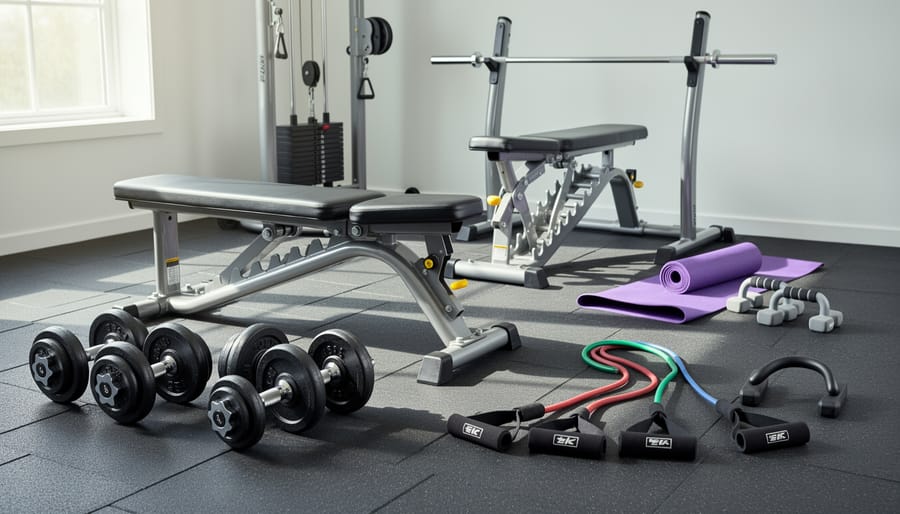
You don’t need much to practice a chest-focused rep, but the setup matters more than the gear. Here’s what helps, and why:
- An adjustable bench: lets you change the incline to shift emphasis between the upper and mid chest.
- Dumbbells: let each arm move independently, so you can squeeze the pecs together at the top.
- A cable station or pec deck: keeps constant tension on the chest through the whole range.
- Resistance bands (optional): a cheap way to add resistance to push-ups or flyes.
- A mirror (optional): shows whether your shoulders are creeping up while your chest should be working.
- A timer or tempo app (optional): helps you hold a steady, slow lowering phase.
Starting loads are where most lifters go wrong. Pick a weight you could lift for 12 to 15 clean reps, even if it feels embarrassingly light. Heavy loads pull your attention toward simply surviving the set, and the shoulders and triceps tend to take over. A lighter, controllable weight leaves you enough mental bandwidth to notice what your pecs are doing.
If you train at home, you can still do all of this. Push-up variations, such as slow tempo, feet elevated, or hands on a pair of books, work well, and a loop band anchored around a door frame mimics a cable fly. A training partner can also watch your shoulders and give feedback. If you like tracking, you can keep a training log with apps to record loads and tempo from session to session.
Safety First: When to Stop and How to Avoid Common Injuries
Chasing the feel of your pecs working is a good goal, but it should never outrank your joint position or your safety setup. Slowing down and lightening the load makes the chest easier to feel, yet it can tempt you to pull the shoulders into a strange position just to chase a deeper stretch.
Keep your shoulder blades set and your elbows at a comfortable angle. Avoid dropping far past a natural stretch under load, especially on dumbbell presses and flyes, because the front of the shoulder tolerates that position poorly when it’s weighted. If a movement only “feels right” when your shoulders roll forward or your wrists collapse, change the setup rather than forcing it.
Use a spotter or set the safeties on any pressing movement. Lighter, slower reps still fail sometimes, and a controlled tempo makes it easy to lose focus on the bar.
It also helps to separate sensations. Muscle burn is a dull, spreading warmth that fades soon after the set, while pain tends to be sharp, localized, or lingering in a joint. The first is part of training; the second is a signal to stop.
If shoulder or pectoral discomfort keeps returning, or you have a heart condition or other health concern, consult a qualified professional such as a physician or physiotherapist before continuing.
Step-by-Step: How to Feel Your Chest Working on Every Rep

Prepare the Body and the Mind: Warm-Up and Priming
Before your working sets, spend five minutes teaching your chest to switch on. Do one or two light sets of push-ups or band flyes, stopping well short of fatigue. The aim is to feel the pecs warm and slightly full, not tired. Then take a few seconds to settle your attention on the muscle itself, perhaps touching the center of your chest and thinking about it contracting. Here is a simple sequence that carries that focus into your first set:
- Warm up and “wake up” the chest with one or two light sets of push-ups or band flyes.
- Set your shoulder blades back and down, keeping your ribs stacked and your posture tall.
- Choose a load you can fully control, lighter than you think you need.
- Slow the lowering phase to a 2-3 second tempo.
- Direct your attention to the pecs, and think of bringing your upper arms together rather than pushing the weight away.
- Pause briefly at the point of greatest chest tension, without letting the shoulders roll forward.
- Exhale and finish the rep with a deliberate squeeze across the chest.
- Reassess your form after each set, and add load gradually only when the feeling stays in your chest.
Treat the first few reps as a check-in. If your shoulders or triceps are the first thing you notice, lower the weight and reset your cues before pressing on.
Choose Exercises That Make the Chest Easier to Feel
Some lifts make the chest easier to feel than others, mostly because of how much else has to work at the same time. Heavy barbell bench pressing asks your shoulders, triceps, and upper back to coordinate under serious load, so your attention gets pulled toward survival and the bar path. Cable flyes, the pec deck, dumbbell presses, and push-up variations tend to strip that noise away. The path is more guided, the loads are lighter, and the chest stays under tension through the whole range.
Bench angle shifts the emphasis. A flat bench loads the mid-chest broadly, while a low incline of about 15 to 30 degrees tends to bring the upper pecs in more. Steeper angles hand more work to the front delts, which can muddy the feeling you’re chasing.
Anatomy and preference matter here. Arm length, shoulder structure, and past injuries change what feels natural, so test a few options and keep the ones where your chest speaks up first.
Cues, Tempo and Breathing That Keep Attention on the Pecs
Start with one simple tactile cue: lightly tap or press your fingertips on the upper chest between sets, then try to feel that same spot tighten when the working set begins. Touch gives your brain a clear target, which is often easier than picturing a muscle you can’t see.
Next, pick a verbal cue that moves your attention away from the weight. “Hug a tree,” “bring your elbows together,” or “squeeze the biceps toward the midline” all describe the same job from different angles. Try each for a set or two and keep the one that makes your pecs, not your shoulders, feel the load.
Pair tempo with breath so your attention has a rhythm to follow. Take about two seconds to lower the weight while inhaling, pause briefly in the stretch, then exhale through a controlled two-second squeeze. Slowing the lowering phase tends to make the muscle easier to feel.
Coaches and traditions don’t agree on the words. Bodybuilders talk about “squeezing,” some strength coaches prefer “pressing the floor away,” and others borrow ideas about body awareness from yoga or dance. None of these is the official language, so treat them as options to experiment with.
How to Tell It’s Working: Verifying Your Connection and Planning Next Steps
The clearest sign the connection is working is where fatigue shows up first. On a set of dumbbell presses or cable flyes, you want the chest to burn and give out before your triceps or front delts do. If your arms quit while your chest feels fresh, the pecs aren’t doing most of the work yet.
Beyond that, look for consistency. Reps late in a set should look like the early ones, with the same elbow path and the same slow lowering phase. Over several weeks, you should also feel stronger on the same movements with the same control, and gradually see more fullness through the chest.
Two simple self-checks help. Keep a training log noting load, reps, tempo and a one-line “where did I feel it?” comment. Then film a set from the side and from above. Video often exposes shoulders rolling forward or elbows flaring in ways you can’t feel.
Progress when you can hit your target reps with clean form and clear chest tension on every rep. Add a little load first, then an extra set, then rotate in a new variation if progress stalls.
If triceps or front delts keep taking over, try these fixes:
– Lower the weight by 20 to 30 percent.
– Narrow your focus to the squeeze at the top.
– Switch to cables or a pec deck, where the arms matter less.
– Check that your bench angle isn’t too steep.
Self-assessment has limits. “Feel” is subjective and can mislead, so treat it as one data point alongside your log, your video and your long-term results. A coach’s outside eye is worth having if you stay stuck.
Common Questions About Chest Mind-Muscle Connection
Short answers to the questions lifters ask most often, with caveats where the research is mixed.
Can you build a mind-muscle connection with heavy weights?
Yes, but it gets harder as the load climbs. Studies on attentional focus tend to find the clearest effect at moderate loads, because near-maximal sets demand so much total effort that conscious focus on a single muscle becomes difficult. Many lifters practice the skill with lighter, controlled work and then carry it into heavier sets as best they can.
How long does it take to feel your chest working?
There is no reliable timeline. Some lifters notice a difference within a few sessions of slowing down and using cues, while others need several weeks of consistent practice. Treat it like any motor skill: frequent, deliberate repetition helps more than occasional effort.
Does it work for everyone, and do beginners need it?
Results vary between individuals and between studies, so it is not a guaranteed fix. Beginners can benefit because early practice builds good movement habits, but they do not need to obsess over it. Learning solid technique and progressively adding load matter more at that stage.
Is the pump the same as muscle growth?
No. The pump is a temporary swelling from blood and fluid in the working muscle, and it can feel convincing, but it is not proof that a workout stimulated growth. Treat it as a pleasant sign of local effort rather than a measurement of results.
Is it necessary to see results?
Not strictly. Lifters have built impressive physiques with a purely external focus on moving the weight, and progressive overload remains the main driver of growth. A strong mind-muscle connection is best viewed as a useful tool, especially if your shoulders or triceps keep taking over, rather than a requirement.
If one theme runs through these answers, it is that attention supports training but does not replace it. Use the skill where it helps, stay honest about what it can and cannot do, and keep your expectations tied to what the evidence actually supports.
Building a mind-muscle connection for your chest comes down to a few repeatable habits: lighter, controllable loads, slower reps, and attention placed on the pecs rather than the bar. None of it is new. Physical culturists a century ago urged lifters to concentrate on the muscle at work, and bodybuilders have refined that habit ever since. Modern research suggests the effect is real but modest, and strongest where the movement is simple and the load manageable.
Treat attention as a skill you can practice, not a replacement for hard training. Progressive overload still drives growth. Focus helps you apply that overload to the muscle you intend to train, and it sharpens your sense of what each rep feels like.
Keep a log, watch your sets on video, and stay curious about your own body. Over time, that awareness will teach you more than any cue ever could.